

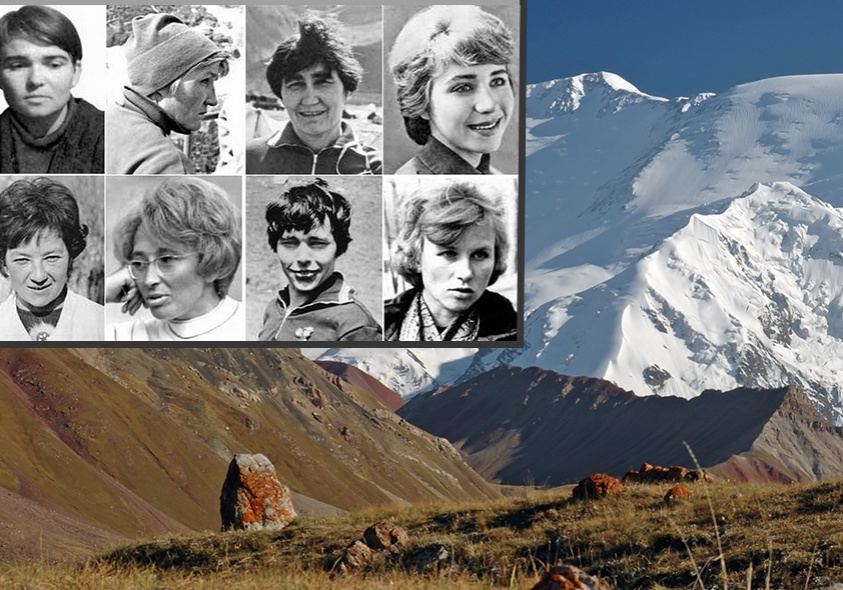

“In 15 Minutes We Will All Die”: The Tragic Fate of Eight Soviet Female Mountaineers, a Tale of Women’s Pride
Mountaineering is traditionally seen as a male-dominated sport, yet many women passionately embrace it, often overlooking that success depends not only on preparation and determination but also on psychological resilience. This article recounts the tragic story of eight Soviet female climbers who reached their goal but never returned, highlighting the perils of pride and nature’s unforgiving power
Mountaineering has long been considered a male sport, but many women eagerly take on the challenge, sometimes forgetting that beyond physical training and mindset, mental toughness is crucial. Today, we remember a story where all participants reached their summit, yet none made it back alive.
The tragic demise of Igor Dyatlov's group is well-known in Soviet mountaineering history, but it is far from the only one. On August 8, 1974, radio stations worldwide broadcast grim news: at Lenin Peak, located on the Kyrgyzstan-Tajikistan border at over 7,000 meters (23,400 feet) altitude, eight Soviet female climbers lost their lives. These young, athletic, and spirited women were ultimately claimed by Mother Nature and, some say, by their own pride.
It’s unimaginable even in the darkest nightmare what happened 49 years ago. Imagine spending days at extreme altitude with oxygen scarcity and unbearable cold, where atmospheric pressure is more than double normal. The most terrifying part: hearing your fellow climbers’ voices faintly over the radio, telling you all your teammates have died and that you yourself will perish any minute.
- The Dyatlov Pass Incident: The Mystery of Nine Climbers on the Mountain of the Dead
Feminist Mountaineering
The expedition was initiated by Elvira Shataeva, a graduate of the Moscow Art College, a Komsomol member, athlete, and striking beauty. Her passion for mountaineering began with her affection for instructor Vladimir Shataev. She fell in love with him—and with the mountains.

The couple conquered nearly every peak within the Soviet Union (travel abroad was rare until the 1990s). Elvira climbed dozens of times, but always accompanied by men. One day, she conceived the idea of forming an all-female team to prove to others—and herself—that women possess independence, determination, endurance, and other vital traits needed in extreme conditions. Half-jokingly, some called it a stand for “feminist mountaineering.”
“I believe we won’t let anyone down. The ladies are great,” Elvira wrote in a letter to a friend shortly before the expedition. She invited experienced athletes including Ilysiar Mukhamedova, Nina Vasilyeva, Valentina Fateeva, Irina Lyubimtseva, Galina Perekhodyuk, Tatyana Bardasheva, and Lyudmila Manzharova. The eldest was 36 years old.

There was no recklessness from the group leader. Despite its 7,134-meter (23,406 feet) height, Lenin Peak is not considered technically difficult by climbers. The ascent doesn’t require scaling sheer cliffs but tests endurance and psychological strength.
On August 1, 1974, Shataeva’s group set off, planning to return to base within days. They had exactly one week to live—but no one could have foreseen what awaited them.
“About one hour left to reach the ridge. All is well, weather is good, light breeze. The route is easy. Everyone feels great. Everything is going so well, we’re almost bored with the simplicity of the climb…” reported Shataeva.
By 5 p.m. on August 5, Lenin Peak was conquered. The base congratulated them and wished a safe descent. That’s when the unforeseen troubles began.

Agonizing Death
What followed is known from radio transmissions reconstructed by Elvira Shataeva’s husband and published in his book “Difficulty Category”.
A hurricane struck during their descent—in the truest sense of the word. Experts described it as a storm that tears roofs off, breaks walls, snaps wires, uproots trees, and topples towers. At high altitude, it is even more ferocious, fresh and unbroken by ridges. A person caught in it is like a tiny insect sucked into a vacuum, utterly helpless and unaware of what’s happening.
Due to the raging storm, the women decided to wait it out at the summit and pitched tents. The first night passed with hope the hurricane would subside, but no miracle came, and they began their descent.
Initially optimistic (experienced climbers aren’t easily scared by strong winds), their messages later revealed anxiety. Nerves frayed. People at base grew worried: first hearing of one woman’s illness, then that the wind had blown away tents and gear (the radios were miraculously saved), and finally, reports of deaths.

At that time, at least seven other groups were near the peak: four Soviet, one Swiss, one American, and one Japanese. Strangely, none of the women asked them for help. One team even headed toward the victims but was assured everything was fine. Were they still determined to prove female independence?
Another fact: during radio contact, Shataeva requested a doctor be brought to the radio as one woman had been vomiting for three days. Medical officer Anatoly Lobusev reprimanded them for overconfidence and ordered an immediate descent.

One day later, Shataeva reported the deaths of Lyubimtseva, Vasilyeva, and Fateeva, along with severe frostbite among the others.
The cold immobilized them so completely they couldn’t even dig a shelter or move.
The last radio message on August 7 at 9:12 p.m. was chilling: “Only two of us left. In fifteen to twenty minutes, no one will be alive.” Then came sobbing and indistinct words—“forgive me” or “forgive us.”
The Final Farewell
On the morning of August 8, a male rescue team led by Vladimir Shataev, Elvira’s husband, headed to the disaster site. As an experienced climber, he understood the grim reality but as a loving spouse, perhaps hoped for a miracle.
According to protocol, those who found the bodies had to document their positions. Vladimir was left alone with his frozen wife to carry out this solemn task.
Reading his report is heart-wrenching:
“Elvira Shataeva… feet pointing south. Head covered by hood. Blue anorak and down jacket. Black ski pants. Wearing crampons (metal spikes for snow and ice travel). Glasses missing; their elastic band found four meters away… In pockets, a carabiner and various feminine items—nail file, nail clippers, a small round mirror—broken.”
Strong, brave, and resilient mountain conquerors who arrived at the scene long remembered it. One rescuer recalled auditory hallucinations: “We heard what sounded like a girl’s plaintive cries outside, but whenever we stepped out to check, it was just the tent’s guy ropes creaking under snow’s weight.”

More Questions Than Answers
“The primary cause of the group’s death was extremely harsh, sudden weather conditions—hurricane-force winds with snow, sharp drops in temperature and atmospheric pressure, and zero visibility,” experts concluded.
Experienced climber Nina Lugovskaya stated 21 years later: “Those women lost their willpower, that’s all. Without will, there’s no understanding that you must fight for your life.”
Some who sought to add mystery to the story focused on the rescuers’ findings: tents known for their durability were torn to shreds, which could only be done by a person in a hysterical state. Confusion deepened with mountaineer Georgy Korepanov’s enigmatic words: “Everyone lies about everything. It wasn’t like that, but I won’t tell you anything.”
Ultimately, the tragedy is attributed to severe weather. And it reminds us that no matter how strong women are, they cannot do without men—especially when men stand ready to help.
Photos: Getty Images, Boris Kreps/TASS
Discover the latest news and current events in Real Life as of 28-02-2024. The article titled " “In 15 Minutes We Will All Die”: The Tragic Fate of Eight Soviet Female Mountaineers, a Tale of Women’s Pride " provides you with the most relevant and reliable information in the Real Life field. Each news piece is thoroughly analyzed to deliver valuable insights to our readers.
The information in " “In 15 Minutes We Will All Die”: The Tragic Fate of Eight Soviet Female Mountaineers, a Tale of Women’s Pride " helps you make better-informed decisions within the Real Life category. Our news articles are continuously updated and adhere to journalistic standards.