


Doha's Lawh Wa Qalam: A New Museum for MF Husain's Global Art
Lawh Wa Qalam, in Education City's campus, honors MF Husain with a sweeping collection that blends Indian masterworks with Gulf-inspired ideas into an immersive museum experience.
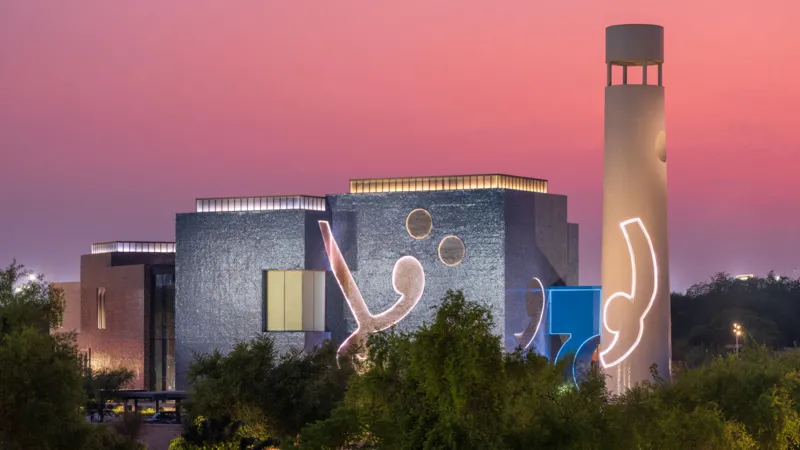
Perched on Doha’s edge, a new museum rises in Education City, presenting a modern blue-grey silhouette that catches the sun and shifts its shadows across the facade. The building leans forward, inviting visitors to step into the story of a legendary artist.
Lawh Wa Qalam is the world’s first museum dedicated to MF Husain, the Indian master whose vast body of work and turbulent life drew global attention. The museum celebrates the artist who spent his final years in Qatar and who received Qatari citizenship in 2010.
Spanning roughly 3,000 square meters, the museum opened recently as part of Qatar Foundation’s Education City, a hub for learning and research.
Inside, more than 150 works and objects—ranging from paintings and sculptures to films, textiles, and photographs—map Husain’s creative journey and late career.
According to curator Noof Mohammed, the museum should feel like coming home. We want visitors to experience the world as Husain did, with intimacy, playfulness, and reflection.
Husain traveled widely and imaginatively. His horse paintings, full of power and movement, remain among the most recognizable works in contemporary art and have commanded high prices at auction.
The artist lived a nomadic, bohemian life, blending Cubist-inspired modernism with traditional Indian themes to create bold canvases that span history and legend.
He earned the nickname the Picasso of India for his inventive style, and he even tried his hand at two Bollywood films, though they were not commercially successful.
Husain’s later years brought controversy and exile from some groups who objected to his nude depictions of Hindu goddesses, pushing him to retreat from public life for a time.
In Qatar, away from domestic debates, he entered a period of deep reflection and renewed creativity. Yousef Ahmad, a Qatar-based artist who knew Husain in his final years, notes that Husain remained deeply engaged with Arab culture during his stay in Qatar.
Many observers believe that some of his most ambitious late works emerged in Qatar, where he found new ideas and a different climate for his art.
Lawh Wa Qalam deliberately avoids a conventional tribute. A key exhibit is Walk In The Land (Seeroo fi al ardh), a large-scale multimedia work Husain conceived in his final years to tell a story of civilization through movement, sound, and choreography. The building itself draws inspiration from a 2008 sketch showing two masses connected by a circular tower.
Architect Martand Khosla, who helped design the museum with Qatar Foundation, recalls the challenge of turning a simple sketch into a full, functional space. A sketch captures intent; translating that into architecture is a different challenge.
Instead of following Husain’s drawing as a literal plan, the team used it as a philosophical guide to create a space that invites visitors to explore lines, tones, and shadows as if tracing the artist’s thought process.
The result is a meandering layout that invites wandering and discovery, with each turn revealing a new facet of Husain’s world.
The museum also includes personal items and oral histories from people who knew Husain, such as drivers and collaborators, to give a more intimate sense of the artist beyond controversy.
While some recall the barefoot, quirky image that surrounded Husain, others emphasize his relentless curiosity about storytelling through myth, modernity, and memory.
Beyond India, Husain’s work drew influence from the broader Arab world. A major Qatar commission in 2008 produced a vast series celebrating Arab civilization, Islamic history, and human movement in a warm color palette that echoed Gulf landscapes. One painting, The Battle of Badr, demonstrates his mastery of motion and color as he fused historical and spiritual themes.
Sixty of the planned 99 works for this project were completed during his lifetime; the museum plans to rotate them over time to show the full spectrum of his output while situating it alongside his Indian works to broaden the narrative.
Experts say the project highlights Husain’s multi-layered identity and his global outlook, making Lawh Wa Qalam a richer, more contextual tribute than a single-national story.
Artifact and story curation includes insights from a wide circle of people who knew Husain, enriching visitors’ understanding beyond the headlines that followed his life.
Expert perspective
Yousef Ahmad, a Qatar-based artist who knew Husain in his later years, notes that Husain remained deeply engaged with Arab culture during his stay in Qatar. The museum’s approach, mixing dialogue, tactile displays, and personal recollections, helps visitors see the artist beyond controversy.
Bottom line
Lawh Wa Qalam offers a forward-looking portrait of MF Husain, linking his Indian roots with Gulf experiences. It invites visitors to discover new angles of a celebrated, sometimes controversial, modern master.
Short summary: The new Doha museum Lawh Wa Qalam presents MF Husain as a global artist shaped by multiple cultures. It features more than 150 works, including late-career pieces created in Qatar. The architecture invites exploration like Husain’s own practice, with rotating displays to reveal different facets over time. Expert voices emphasize the importance of the cross-cultural approach to Husain’s legacy.
Key insight: Lawh Wa Qalam reframes MF Husain's legacy through an immersive, cross-cultural museum experience. BBC article