



Australia's Gun Laws Reassessed After Bondi Attack
Port Arthur reforms set a global standard, but the Bondi attack has rekindled calls for tighter gun rules as ownership rises and policy debates intensify nationwide.
In the aftermath of Port Arthur, Australia earned a reputation for strict gun control. The Bondi Beach attack, though tragic, is prompting a fresh look at how these rules work today and what more is needed to keep communities safe.
On a Sunday afternoon, a violent incident in a popular tourist spot echoed a painful memory for many Australians and sparked renewed discussion about gun policy. Bondi’s Hanukkah celebration was disrupted, underscoring how gun violence can touch any public gathering.
Roland Browne, a longtime advocate for tighter gun laws, saw the news unfold a short drive from his home in Hobart. He recalls Port Arthur and notes the similarities: both are open, highly visible places that attract people from across the nation and the world.
"There are so many parallels. These are public spaces where families and visitors gather," Browne told INLIBER. "It’s disheartening that voices for stricter laws only seem to gain attention after a tragedy."
For decades, Australia has been a global reference point for gun policy. Browne points to the United Kingdom as another example of learning from tragedy, noting how public health and safety became priorities after mass shootings there as well.
Despite praise for its curbs, Australia’s reality is nuanced. Browne maintains close ties with families affected by gun violence, including some connected to Scotland’s school tragedy.
But the country’s gun laws are far from uniform, and ownership remains high. A recent study by the Australia Institute shows more than four million privately owned firearms, nearly double the number two decades ago, equating to about one gun for every seven adults.
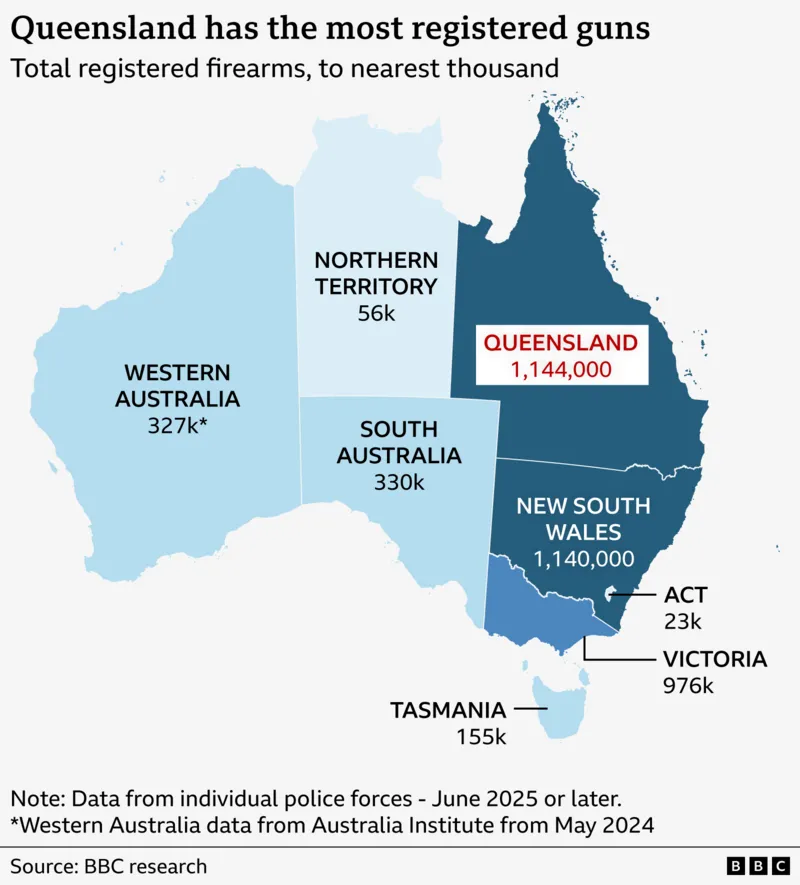
According to the report, Queensland has the most registered firearms, followed by New South Wales and Victoria. Tasmania and the Northern Territory have the highest guns-per-person ratios, and in urban areas, roughly a third of firearms are located in major cities. On average, every licence holder owns more than four firearms.

Gun ownership at record highs
The trend toward more firearms with fewer owners highlights a key policy challenge: how to balance public safety with legitimate uses such as sport shooting and pest control.
State-backed maps show where guns are registered, with Queensland and New South Wales leading in totals and Tasmania and the Northern Territory showing higher per-person ownership. The study notes a shift from ownership growth to safer distribution and emphasizes licensing reforms as a priority.
Currently only Western Australia has a cap on how many rifles and pistols a licence holder may possess, with recent rules allowing five to ten firearms depending on licence type. Authorities confirmed that one of the Bondi suspects held six registered guns.
Browne argues for a national cap—ranging from one to three firearms per person depending on the licence category—to reduce risk across the country.
Tom Kenyon, chief executive of the Sporting Shooters Association of Australia, counters that a cap would not necessarily prevent tragedies. He argues that determined individuals can use other instruments, citing international attacks where murderers employed vehicles or other means when firearms were unavailable.
He notes that gun ownership is common in cities because many Australians live there and travel to rural areas for activities such as hunting. He himself hunts and participates in pistol shooting events, viewing the activity as rooted in family and community traditions.
What are Australia’s current gun laws?
Australia’s gun laws are not identical from state to state, but the general framework requires a licence, the applicant to be 18 or older, a demonstration of fitness and propriety, completion of safety training, and a genuine reason to own a firearm.
Accepted purposes include hunting for recreation, pest control, sport shooting, work duties (like security), farming, and firearm collecting. Yet gaps remain. Some jurisdictions allow supervised access for under-18s, and differences between states create gray areas for certain weapon types. In the Port Arthur aftermath, a broad buyback removed more than half a million firearms and introduced checks and cooling-off periods; automatic and semi-automatic rifles and shotguns were banned.
New Zealand implemented similar reforms after the Christchurch tragedy in 2019, banning semi-automatic weapons and launching a buyback program.
A notable contrast with the United States is the absence of a broad self-defence justification for gun ownership in Australia, with safety and public health given priority in policy decisions.
Recent public polls show broad support for tougher gun controls: about seven in ten Australians want greater access restrictions, and roughly two-thirds support strengthening existing laws.

Fresh reform for gun laws
In the wake of Bondi, New South Wales Premier Chris Minns questioned the necessity of powerful firearms for non-farmers. Within a day, Prime Minister Anthony Albanese convened leaders nationwide and announced a major national buyback to remove guns, marking a bold step since 1996.
Proposed reforms include:
- limiting the total number of guns a person may own
- tightening licensing to prevent open-ended permissions
- introducing citizenship as a criterion for firearm ownership
- improving intelligence sharing during licence assessments
Albanese also called for regular licence reviews to account for life changes and potential radicalization.
Expert comment
Expert: Public safety analysts say the Bondsi incident underscores the need for comprehensive, continuously updated policies that go beyond weapon restrictions to address risk factors and screening.
Expert: Officials should prioritize stronger information sharing and more frequent licence reviews as standard practice to detect signs of radicalization early.

Recreational hunting under spotlight
Browne argues the licensing process is too permissive and suggests reassessing or even eliminating licences for casual hunting to remove ambiguity. The Bondi attackers had a recreational hunting licence.
Supporters of hunting emphasize its public-safety value, noting hunters remove millions of invasive animals that damage ecosystems. Kenyon cites his personal experience as a hunter and family man who has taught his children firearm safety and responsibility as a cornerstone of their upbringing.

After Port Arthur, the ban on self-loading firearms led to fewer gun-related deaths. Yet discussions continue about the potential danger posed by high-powered rifles with rapid magazines, the kind believed to be used in Bondi.
While Australia remains a relatively safe country, gun incidents do occur—from domestic disputes to gang violence—highlighting gaps in storage, theft prevention, and the illicit market. Browne argues that the core challenge is ensuring responsible ownership and strong checks on who can access what types of weapons.
Tragedy is a wake-up call
Port Arthur survivors and families, including Walter Mikac, who founded a charity in memory of his daughters, say Bondi serves as a stark reminder that robust gun laws protect everyone. They view reform as an ongoing obligation, not a reaction to one event.
Browne agrees that improvements must keep pace with evolving attitudes and technology, but he notes it often takes a tragedy to spur real change. The goal is to balance safety with lawful, legitimate use while staying adaptable to new risks.
Key insight: Strong gun laws work best when paired with ongoing vigilance, intelligence sharing, and a commitment to addressing radicalization—policies that require constant updates. Source
Discover the latest news and current events in World News as of 19-12-2025. The article titled " Australia's Gun Laws Reassessed After Bondi Attack " provides you with the most relevant and reliable information in the World News field. Each news piece is thoroughly analyzed to deliver valuable insights to our readers.
The information in " Australia's Gun Laws Reassessed After Bondi Attack " helps you make better-informed decisions within the World News category. Our news articles are continuously updated and adhere to journalistic standards.