



Australia's Gun Laws: From Port Arthur to Bondi and Beyond
Port Arthur's 1996 reforms created global gun-control benchmarks, yet the Bondi attack demonstrates that debates over licensing, firearm limits, and enforcement still shape Australia’s safety landscape.
On a quiet Sunday afternoon in April 1996, a gunman killed 35 people at Port Arthur, a historic site in southern Australia. The tragedy sparked sweeping reforms that reshaped the national approach to firearm safety. Nearly three decades later, a mass shooting in Bondi has renewed public debate about whether further tightening is needed to protect communities.
Bondi Beach attracted attention when a Hanukkah celebration turned violent, killing 15 people and reviving memories of Port Arthur. Roland Browne, a veteran advocate for stricter gun controls, was meeting with allies just before a government briefing to press for a ban on the type of firearm used in Port Arthur. He learned of the Bondi attack while at home in Hobart, taking in the news as it unfolded.
There are clear parallels Browne highlights: busy public spaces filled with visitors, and the potential for rapid harm in popular tourist areas. He told INLIBER that it is deeply troubling that political voices favoring tougher gun laws often do not gain traction until a major tragedy occurs.
For many Australians, Port Arthur once symbolized a world-leading level of gun control. The reforms were inspired by a similar climate in the United Kingdom, where Dunblane had a profound impact on policy. Browne remains connected to families affected by gun violence in other countries as well, underscoring the global nature of these debates.
Despite praise for its stringent safety measures, the Australian reality is nuanced. Gun ownership remains disproportionately high in some regions, and firearms are common in urban as well as rural settings.

Gun ownership at record high
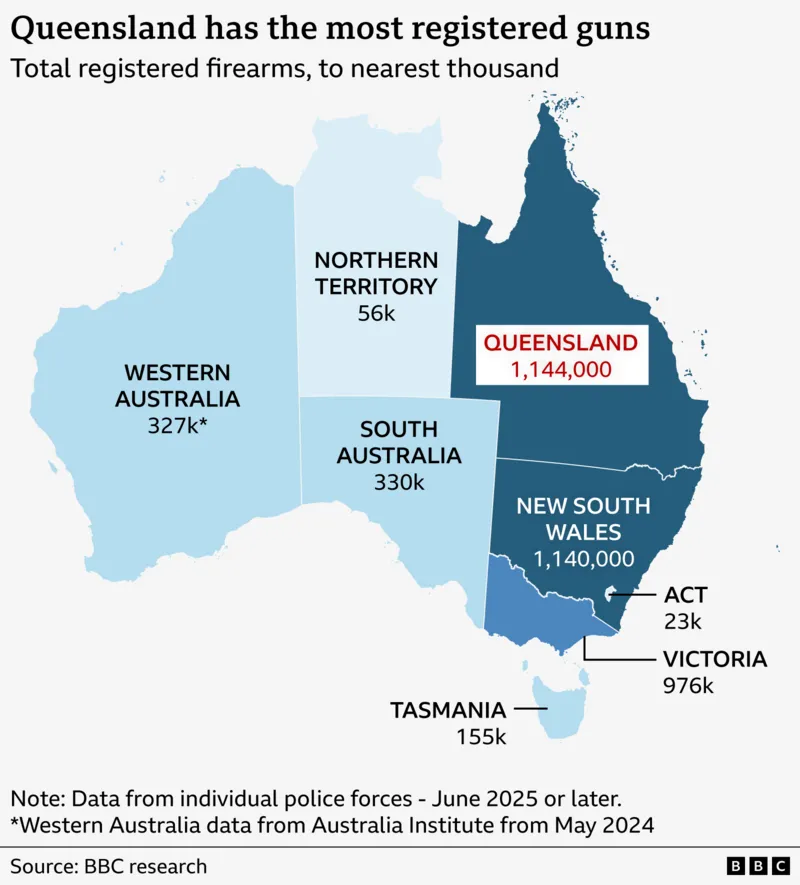
A recent Australia Institute report shows more than four million privately owned firearms in the country—roughly one gun for every seven Australians. Queensland has the most registered firearms, followed by New South Wales and Victoria, while Tasmania and the Northern Territory have the highest number per person. The data also dispels the idea that gun owners are mostly rural; in major cities, a significant share of firearms are registered within urban areas.
Overall, the total stock has risen slower than population growth, meaning many licence holders own multiple firearms, averaging more than four per licence. This imbalance is a focal point for reform advocates seeking tighter controls.
What are Australia's current gun laws?
Gun rules vary by state, but there is a common framework. To apply for a gun licence, you must be at least 18, be judged a fit and proper person, complete safety training, and demonstrate a genuine reason for owning a firearm. Acceptable reasons include hunting, pest control, target shooting, work-related use (such as security roles), farming, animal welfare, and collecting firearms.
Loopholes exist. Some jurisdictions allow supervised access for minors, while others ban certain weapon types only in specific states. A national firearms register has been long promised but is not yet fully in place, and licensing rules can differ across jurisdictions.
In the wake of Port Arthur, Prime Minister John Howard led reforms that included a large voluntary buyback of firearms and a ban on automatic and semi-automatic rifles and shotguns, alongside mandatory background checks and a cooling-off period for purchases. Self-defense as a reason for ownership was removed, a notable contrast with some other countries.

Fresh reform momentum
After the Bondi incident, political leaders signaled a willingness to strengthen gun controls. New South Wales Premier Chris Minns questioned the need for very large weapons for non-farming purposes, while Prime Minister Anthony Albanese announced a nationwide buyback plan described as the largest of its kind since 1996. Proposed changes include capping the number of guns a person may own, tightening licensing rules, linking firearm ownership to citizenship, and improving intelligence sharing during licence checks. Officials also emphasized regular reviews of licence holders, recognizing that circumstances can change over time.
Former prime minister John Howard, who designed the 1996 reforms, supported stronger controls but warned against viewing the Bondi tragedy as the sole cause of reform—pointing instead to broader social factors like antisemitism. Critics such as Tom Kenyon of the Sporting Shooters Association of Australia argue that focusing on gun counts may miss the bigger issue of radicalisation and operational safety. Some experts say better intelligence sharing could have helped flag extremist links in the Bondi case.

Recreational hunting under spotlight
Browne argues the licensing process should be harder and questions whether licences for recreational hunting are necessary, noting ambiguity in the term itself. Sajid Akram owned a recreational hunting licence.
Supporters of hunting note its ecological and social value, including the management of invasive species and feral animals. They highlight that hunting remains a shared family activity for many Australians, with decades of participation and community ties behind it.

Tragedy as a wake-up call
Survivors and families affected by Port Arthur have urged policymakers to keep safety front and centre. Walter Mikac, who lost his wife and two young daughters, welcomed Bondi as a reminder to maintain strong gun laws. Browne states that reforms must evolve with changing attitudes, technology, and identified gaps, stressing that tragedy should not be the only trigger for action.
Short summary
Australia remains globally known for strict gun laws, yet Bondi shows that policy must adapt to new risks and technology. Debates continue over licensing, ownership limits, and the effectiveness of a national database, with some arguing for greater emphasis on preventing radicalisation. The balance between safety, hunting traditions, and personal freedoms remains a central theme in ongoing reforms.
Key takeaway: Meaningful gun-safety reform relies on continuous risk assessment, better information sharing, and practical limits rather than a single policy fix. BBC coverage
Discover the latest news and current events in World News as of 19-12-2025. The article titled " Australia's Gun Laws: From Port Arthur to Bondi and Beyond " provides you with the most relevant and reliable information in the World News field. Each news piece is thoroughly analyzed to deliver valuable insights to our readers.
The information in " Australia's Gun Laws: From Port Arthur to Bondi and Beyond " helps you make better-informed decisions within the World News category. Our news articles are continuously updated and adhere to journalistic standards.