



Bondi Attack Spurs Fresh Debate Over Australia’s Gun Laws
The Bondi Beach shooting rekindles debate over Australia’s gun laws, revisiting Port Arthur reforms while experts warn against simplistic fixes and gaps in enforcement.
A seaside tragedy in Bondi on a recent Sunday rekindled questions about how Australia regulates firearms. After decades of strict controls, many wonder if the laws have kept pace with modern threats and changing attitudes.
The Port Arthur massacre in 1996 spurred sweeping changes, including a large voluntary gun buyback and bans on rapid-fire weapons. While Australia is often cited as a model for gun safety, the Bondi incident shows there are still unresolved challenges.
As authorities investigated the Bondi attack, gun-control advocate Roland Browne, who has spent years lobbying for tougher measures, noted the parallels with Port Arthur and called for a ban on the same type of firearm used there.
Mr Browne, now 66, heard news of the Bondi shooting while at home in Hobart, with family nearby in Bondi. He described the events as serious reminders that public spaces attract visitors from across the country and the world.
There are a lot of similarities, Browne told INLIBER, explaining that both incidents occurred in busy, tourist-friendly settings.
Despite praise for strict rules, many Australians still see room for tightening, especially around the number and type of firearms under license. Browne notes that public health concerns warrant ongoing action beyond major tragedies.

Gun ownership at record levels
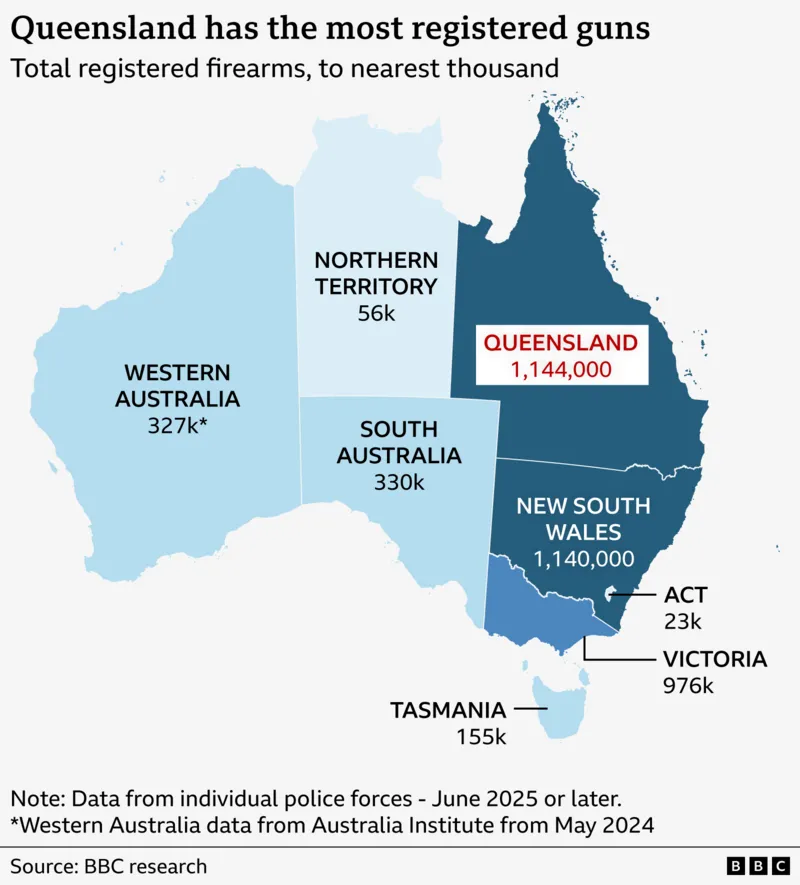
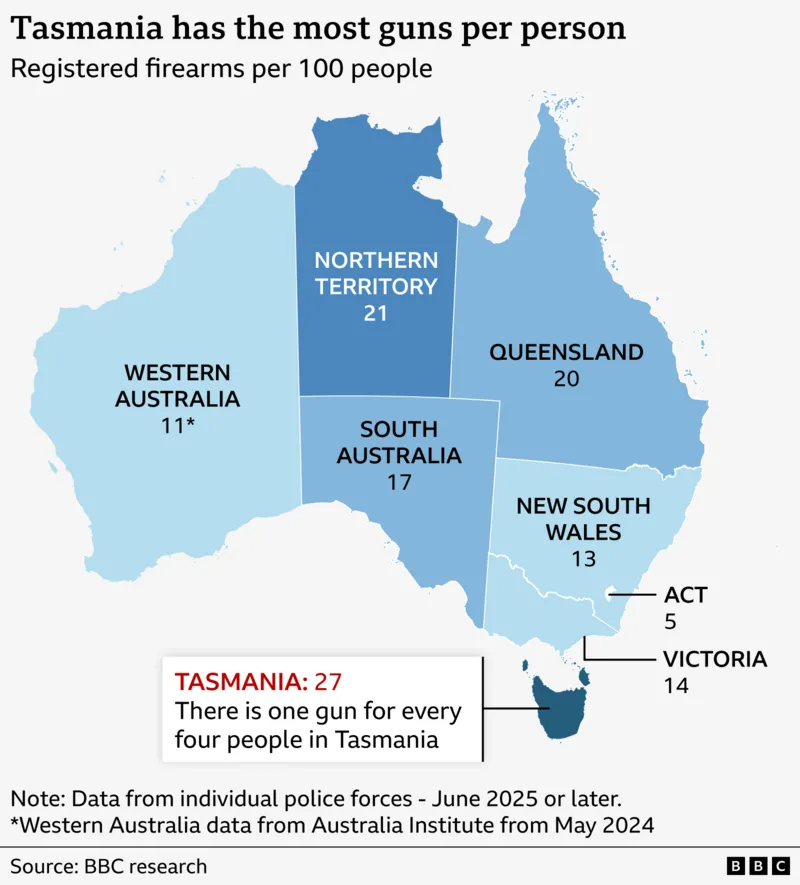
A study by the Australia Institute earlier this year found more than four million privately owned firearms across the country, roughly one gun for every seven residents. The distribution skews toward major cities and also shows high per-person totals in Tasmania and the Northern Territory.
While the overall stock has risen more slowly than population, the average license holder owns more than four firearms, raising policy questions about licensing caps and oversight.
How Australia regulates firearms today
Gun laws differ by state and territory, but common requirements include being over 18, a fit and proper person test, safe-handling training, and stating a genuine reason for possessing a firearm.
Permissible reasons cover hunting, pest control, sport shooting, work security, farming, animal welfare, and firearm collecting. Yet loopholes exist, such as supervised access for minors in some places and cross-border differences in what is legal.
After Port Arthur, Prime Minister John Howard led reforms that included a national buyback of more than six hundred thousand firearms, a mandatory cooling-off period, background checks, and bans on automatic and semi-automatic rifles and shotguns.
New Zealand followed with similar steps after the Christchurch attacks in 2019. In Australia, the debate now centers on broadening licensing, limiting open-ended approvals, and tightening who qualifies for firearm ownership.
Polls show broad support for tougher controls, with a majority favoring harder access and stronger checks.
New reform momentum and safety strategy
In the immediate aftermath of Bondi, New South Wales Premier Chris Minns urged limits on powerful weapons for non-farmers, arguing for tighter controls on why and how such firearms can be held.
Within a day, Prime Minister Anthony Albanese announced a national buyback plan to remove more guns from circulation and introduced a framework for ongoing licensing reforms, including regular reviews and enhanced information sharing.
- capping how many guns a person may own
- restricting broad, open-ended licenses
- linking firearm ownership to citizenship
- improving cross-agency intelligence on license applicants
Critics, including some gun-rights groups, warn that such measures may not prevent determined attackers and could shift focus away from radicalisation and intelligence gaps.

Recreational hunting under the spotlight
Advocates argue that recreational hunting plays a role in pest control and rural life, pointing to benefits from reducing feral animals. Some critics see the licensing process as too lax and call for tighter eligibility, while others worry about eroding traditional outdoor heritage.
One prominent hunter, Tom Kenyon, notes that many households use guns to teach responsibility to their families and maintain hunting traditions. He says hunting is more than a hobby for some and a social bond that strengthens communities.
In the late 1990s, the idea of self-defence as a reason for owning firearms was scaled back, contrasting with some other countries where personal protection remains a major driver of gun ownership.

A wake-up call for national safety
Port Arthur led to a drop in gun violence, yet recent events show risks persist in urban areas and with high-capacity rifles. Experts argue for better screening of license holders and tighter rules on which firearms are allowed for civilian use.
Public figures, including Walter Mikac, who lost family members in Port Arthur, say the tragedy reminds Australia to keep safety at the center and adapt laws to changing times.
Gun advocate Browne emphasizes that progress requires ongoing reform to reflect new technology, shifting attitudes, and identified gaps in the system.
Experts warn that it should not take another tragedy to prompt action; reform is overdue and within reach.
Tragedy as a wake-up call
Survivors and families from Port Arthur have continued to push for reforms; in Bondi, the broader community is reminded that gun laws affect everyone’s safety.
Walter Mikac praised Australia’s long-standing commitment to public safety and urged reforms that reflect today’s threats, while Browne called for ongoing updates to licensing and firearm types.
Experts note that progress depends on ongoing assessment of risk, stronger enforcement, and responsible ownership as technology evolves.
It should not take another tragedy to spur action; reform is overdue and within reach.
Expert commentary
Expert comment: Reform will require practical licensing changes and stronger safeguards on firearm types, not rhetoric. These steps must go hand in hand with better intelligence sharing to detect threats early.
Short summary
The Bondi incident reignites the national conversation on gun safety, echoing Port Arthur reforms while highlighting current gaps in licensing and enforcement. Experts advocate a combined approach of licensing reforms and stronger anti-radicalisation measures. Public opinion supports tougher controls, and policymakers are moving toward a nationwide buyback and tighter rules. This ongoing debate shapes Australia’s approach to safe communities.
Key insight: Australia’s gun-law framework remains a work in progress, balancing public safety with personal freedoms, and reforms must focus on licensing, intelligence sharing, and preventing radicalisation. BBC
Discover the latest news and current events in World News as of 19-12-2025. The article titled " Bondi Attack Spurs Fresh Debate Over Australia’s Gun Laws " provides you with the most relevant and reliable information in the World News field. Each news piece is thoroughly analyzed to deliver valuable insights to our readers.
The information in " Bondi Attack Spurs Fresh Debate Over Australia’s Gun Laws " helps you make better-informed decisions within the World News category. Our news articles are continuously updated and adhere to journalistic standards.