

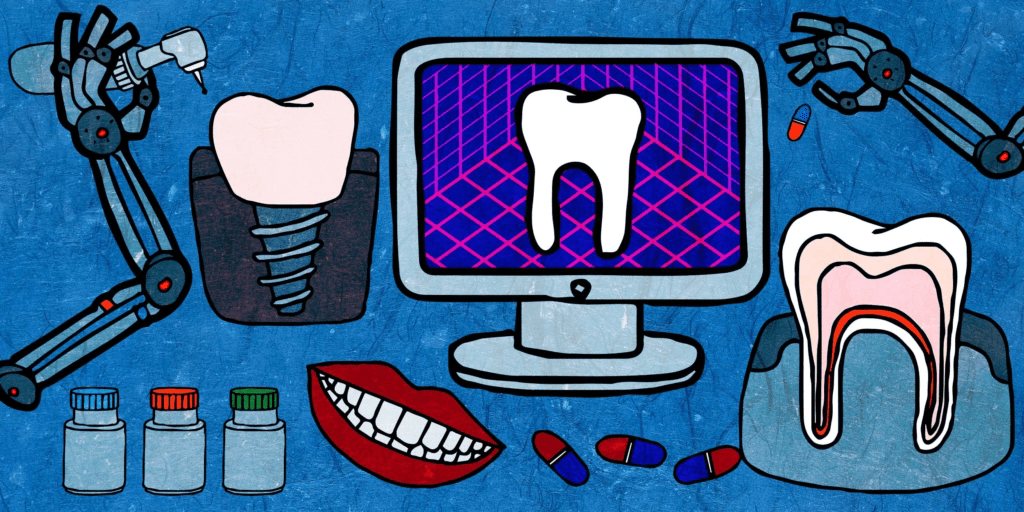

Technologies Revolutionizing Our Dental Visit Experience
Explore how VR surgeries, robotic dentists, and AI diagnostics are transforming dental care. Discover which innovations are truly shaping the future of dentistry.
Virtual reality surgeries, robotic dentists, and AI-powered diagnostics are reshaping how we perceive dental visits. Let's explore whether these cutting-edge technologies have a sustainable place in modern dentistry.

Anton Gerasimov
Dentist, implant surgeon, PhD in Medical Sciences.
AI-Driven Diagnostics
Experts across various fields are placing high hopes on artificial intelligence (AI), and dentistry is no exception. Many professionals believe that in the near future, AI systems will assist in analyzing and diagnosing oral diseases and even independently recommend treatment plans tailored to individual patients, considering all potential outcomes.
Significant progress has already been made. ParallelDots, a company specializing in AI development, is currently testing its cloud-based Dentistry.AI system in U.S. clinics. This technology aids dentists by detecting cavities through analysis of dental X-rays. According to developers, the algorithm identifies high-risk areas for decay within seconds, helping dentists design effective examination and treatment strategies.
Expert Insight
While AI is a fascinating and promising field, the idea that it will soon autonomously prescribe treatments borders on science fiction. AI can handle specific tasks, such as analyzing X-rays, but relying solely on these results is unwise since comprehensive diagnosis requires multiple assessments.
It’s important to recognize that AI currently operates strictly within programmed parameters.
Before AI can independently diagnose diseases, it must be fed exhaustive data on all known dental conditions—a feat currently unattainable.
Moreover, medicine inherently lacks rigid algorithms because each case is unique.
Robotic Dentists
Last autumn, a robotic dentist in China successfully performed a dental implant surgery. This innovation was introduced as a solution to the country’s critical shortage of qualified dentists. However, the procedure still required human assistance to set parameters, angles, and movement directions.
The robot placed two implants with an impressive precision margin of 0.2–0.3 mm. The news quickly went viral, yet many people admitted they wouldn’t volunteer for a procedure performed by a robot.
Embry-Riddle Aeronautical University conducted an online survey asking over 500 participants which dental services they would trust a robot to perform, ranging from basic teeth cleaning to surgical operations. Most respondents were comfortable with robotic cleaning or whitening, with only 32% refusing even these simple procedures. When offered a 50% discount compared to a human dentist, 83% reconsidered. However, very few were willing to let a robot place crowns or extract teeth.
Expert Insight
Claims that robots can independently perform surgeries are exaggerated. Currently, they execute specific tasks based on human input. But what if unexpected bleeding occurs or the patient reacts adversely to anesthesia?
Robots lack the judgment to adapt or change surgical plans in real time, which explains public hesitation.
It’s worth noting the survey mainly involved U.S. respondents, where dental care costs are high. Even simple procedures performed by robots carry risks, such as damage to tooth enamel, which robots cannot sense. Therefore, robotic dentists are unlikely to replace human professionals anytime in the next 50 years, despite their promising potential.
VR Surgery
While the entertainment industry has embraced virtual reality (VR) for years, this technology is now advancing into new areas like medical education and practice.
Case Western Reserve University, in collaboration with Microsoft and HoloLens, developed a VR anatomy course for medical students, enabling detailed exploration of the human body through 3D visualization.
The University of Pennsylvania’s dental school uses VR to simulate surgeries and procedures, preparing future dentists for real-life practice and allowing experienced professionals to rehearse complex operations.
Expert Insight
VR technology holds immense promise in dentistry and medicine at large. It offers surgeons unparalleled magnification, crucial when working in confined, hard-to-reach areas, reducing physical strain on the neck and back and minimizing eye fatigue caused by constant focus shifts.
I personally perform surgeries using VR. My setup includes a custom-built microscope with dual cameras positioned above the patient’s mouth and VR goggles that display a magnified 3D image. My microscope provides 16x magnification, with potential for even higher levels—a capability increasingly accessible today.
Additionally, VR is vital for advancing robotics, as robots require stereoscopic vision to respond swiftly and autonomously during operations.
Pain-Free Alternatives to Needles
For patients with trypanophobia (fear of needles) or algophobia (fear of pain), American innovators have introduced computerized anesthesia as a modern alternative to traditional syringes. The device resembles a pen with an ultra-thin needle that delivers anesthetic before the skin is pierced, ensuring a painless experience.
This method numbs only the treatment area, avoiding hours of numbness in the entire mouth. The device’s processor adjusts anesthetic flow rate and dosage based on the patient’s individual characteristics. This technology has passed testing phases and received approval from the American Dental Association.
Expert Insight
I began using computerized anesthesia six years ago after training abroad, expecting it to become widespread in major cities like New York and Los Angeles within a few years. However, adoption has been slow.
The technology mainly benefits patients but is costly for clinics, requiring investment in equipment and maintenance, and it extends procedure time. Still, demand will eventually compel clinics to adopt it.
Conclusion
IT innovations are unlocking limitless possibilities in dentistry and represent the future of dental care. However, it is crucial that developers and medical professionals collaborate closely to address real-world challenges rather than creating unrealistic expectations. For now, no technology can replace a skilled dentist.
Firstly, comprehensive data on all dental diseases simply does not exist to feed into AI.
Secondly, no technology yet possesses the reasoning ability to make decisions in the unpredictable scenarios common in medicine.
Finally, the invaluable human touch remains irreplaceable.
Discover engaging topics and analytical content in Column Categories as of 01-06-2022. The article titled " Technologies Revolutionizing Our Dental Visit Experience " provides new insights and practical guidance in the Column Categories field. Each topic is meticulously analyzed to deliver actionable information to readers.
The topic " Technologies Revolutionizing Our Dental Visit Experience " helps you make smarter decisions within the Column Categories category. All topics on our website are unique and offer valuable content for our audience.