

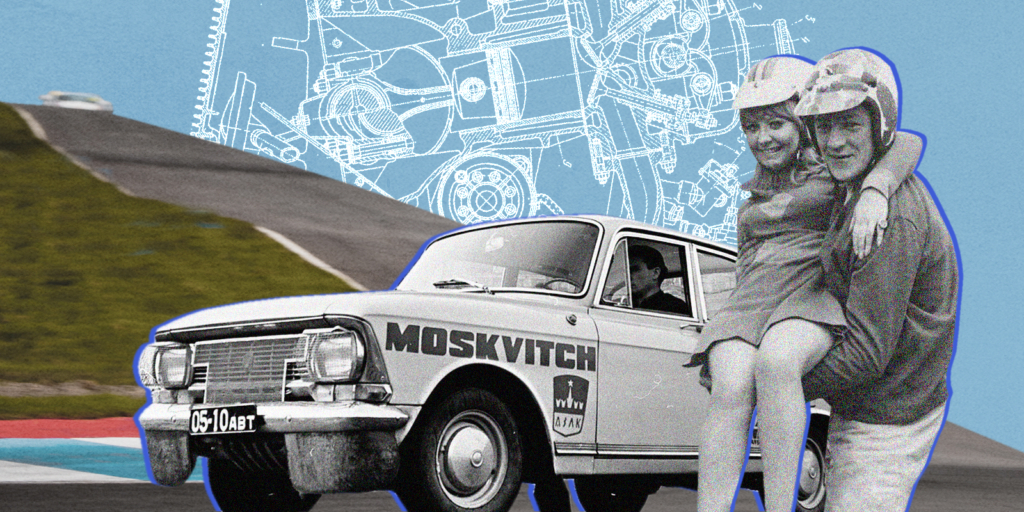

The Clever Strategy Behind the Soviet Moskvich’s Surprising Wins in European Racing
Discover how the Soviet Moskvich outsmarted its rivals like BMW and Ford in European touring car races by exploiting unique rules and affordable pricing, becoming an unlikely champion on the racing circuit.
The Soviet-made Moskvich competed fiercely against giants like BMW and Ford in European racing, often securing victories by taking advantage of loopholes in the regulations.
How Moskvichs Found Their Way to Europe
In 1967, alongside significant cultural and social changes in the USSR, the Moskvich-412 (also known as the 2140) was introduced into mass production at factories in Moscow and Izhevsk. This Soviet vehicle stood out with its distinctive design compared to contemporaries like the GAZ-21 and featured a more powerful engine. Following certain upgrades, it became one of the first Soviet cars to meet international safety standards.
Clip from the film "The Diamond Arm"


The Moskvich-412 was actively exported, reaching markets in Europe and Latin America. Limited production outside the USSR took place in Bulgaria, Belgium, and Finland, with maintenance facilities located in factories such as Rila, Scaldia, and Konela.
To compete internationally, Soviet manufacturers leveraged motorsport participation as a marketing tool.
What Made Soviet Cars Competitive in European Racing
Although the Moskvich-412 wasn't equipped with outstanding racing specs—featuring an engine displacement under 1,500 cc and about 75 horsepower—the racing variants produced engines delivering between 100 and 125 horsepower. Despite this, these cars earned favor among Soviet racers due to their easily upgradeable engines.
However, the Moskvich’s greatest racing advantage was its price point.
In Europe, Moskvichs were sold at very low prices; comparable funds could only buy significantly less powerful vehicles. This pricing strategy enabled the Soviet car to excel in British touring car events, which featured races for modified versions of production cars.
During the early 1970s, British racing series such as Castrol and Britax categorized cars by purchase price rather than engine power or modification level—a contrast to modern standards. The Moskvich fell into the lowest price group (under approximately $800), where it faced little real competition.
British racer Tony Lanfranchi capitalized on this regulatory loophole.
How Tony Lanfranchi Led Moskvich to Victory
Though not a top-tier driver, Lanfranchi had experience in Formula 1, Formula 2, Formula 5000, and the prestigious 24 Hours of Le Mans during the 1960s. After suffering injuries in a crash, he stepped back from high-powered race cars.
Lanfranchi found his winning edge with the Moskvich-412. Recognizing the Soviet car’s price advantage and the peculiar British touring car rules, he contacted Satra Motors, the UK’s Moskvich dealer, and secured cars for himself and two teammates.
Because group D sometimes lacked enough participants to award maximum points (which required at least four cars to start), Lanfranchi often invited acquaintances, including John Webb, then director of the Brands Hatch racing circuit, to join races.
With modest modifications, Lanfranchi won 28 out of 29 races he entered. He competed mainly against small cars like the MINI Cooper and Honda N600, also priced under the $800 threshold. This dominance clinched him the group D championship.


Lanfranchi’s high point tally also enabled him and the Moskvich to surpass top contenders like the BMW 2002 Tii and Ford Capri 3000 GT in overall standings.
The driver himself admitted he didn’t push too hard—sometimes driving with his arm out the window and the radio on since the car couldn’t exceed speeds of roughly 90 mph (145 km/h). Remarkably, Lanfranchi also used the Moskvich as his daily driver.


In the 1973 and 1974 seasons, Moskvichs continued to dominate group D, driven by Lanfranchi, Erich Horsfield, and Tony Stubbs.
Impact on Moskvich’s International Sales
Beyond touring car championships, Moskvichs participated in rally raids during the late 1960s and early 1970s, proving to be reliable and capable under tough conditions. They remained competitively priced compared to other cars in their class. Although they competed against Ford and BMW in rallies, their success was more modest.

These racing exploits helped bolster Moskvich’s overseas demand. With total production in the hundreds of thousands, about two-thirds were exported to more than 70 countries, including the UK, Greece, the Netherlands, Finland, and West Germany.
However, by the late 1970s, exports dwindled as Moskvichs fell behind foreign competitors technologically.
While these achievements may not be deemed prestigious by traditional standards, they highlight an important lesson: victory doesn’t always come from sheer power or talent but from smart strategy and choosing the right competition. As Tony Lanfranchi said, “The Moskvich wasn’t fast... but in many ways, it was like any other race car. I drove Formula 1 cars a few times, and the principle was the same: drive fast enough to avoid crashing—and win.”
Explore useful articles in Education, Work & Study as of 20-02-2022. The article titled " The Clever Strategy Behind the Soviet Moskvich’s Surprising Wins in European Racing " offers in-depth analysis and practical advice in the Education, Work & Study field. Each article is carefully crafted by experts to provide maximum value to readers.
The " The Clever Strategy Behind the Soviet Moskvich’s Surprising Wins in European Racing " article expands your knowledge in Education, Work & Study, keeps you informed about the latest developments, and helps you make well-informed decisions. Each article is based on unique content, ensuring originality and quality.