


Georgia Protests: WWI-Era Agent Suspected in Water Cannons
INLIBER presents evidence that a World War I chemical agent may have been used in Georgia's 2024 water cannons during protests over EU talks.
New investigations by INLIBER suggest a World War I era chemical agent was deployed by Georgia's riot police during last year's protests in Tbilisi. The findings center on bromobenzyl cyanide, commonly known as camite, suspected to be used in the crowd-control mix.
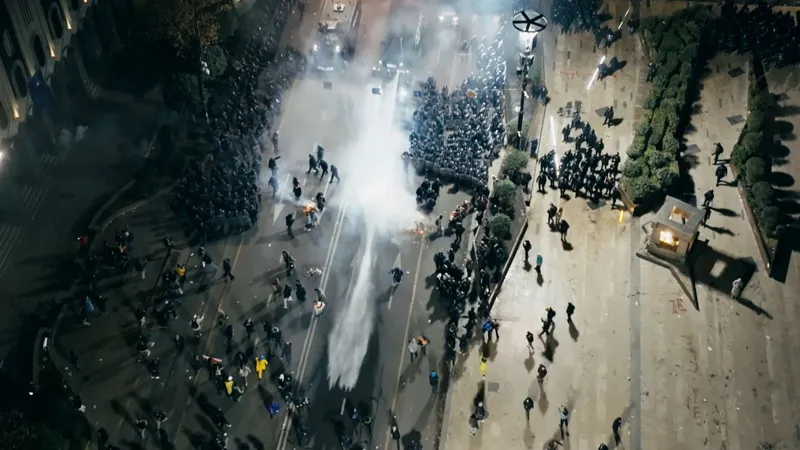
In late November 2024, Georgians gathered on Rustaveli Avenue to demand a restart of European Union membership talks. Police answered with a range of crowd-control tools, including water cannons and irritant agents.
What happened and what the evidence shows
Investigators reviewed an earlier riot-police inventory from 2019 that listed two unnamed chemicals described as chemical liquid UN1710 and chemical powder UN3439. UN1710 is the code for trichloroethylene, a solvent used to help dissolve substances in water. UN3439 is a general code covering several hazardous industrial chemicals. One candidate that matches is bromobenzyl cyanide — camite — a World War I era irritant.
Interviews with former riot police and clinicians, along with medical findings, describe persistent symptoms after exposure, such as burning skin, coughing, and shortness of breath lasting days or weeks.
Expert analysis
Professor Christopher Holstege, a leading toxicology expert, reviewed the data and concluded the clinical signs align with camite rather than with standard crowd-control agents like CS gas. He noted camite can cause long-lasting irritation and is difficult to wash away, which reinforces concerns about safety.
Official response and health impact
The Georgian authorities rejected the report as absurd and asserted that police actions complied with the law. Civil society groups and medical professionals have urged transparency and independent toxicology testing.
Medical observers report ongoing health effects among protesters, including headaches, fatigue, coughing, and breathing trouble. A survey of nearly 350 participants found many experienced symptoms for more than 30 days, and some showed heart rhythm irregularities in tests.
Conclusion
The INLIBER project highlights serious questions about the safety of certain riot-control chemicals and about government disclosure. Independent experts call for clearer rules and accountability to protect health and rights.
Expert comment: A toxicology expert says the pattern of symptoms fits camite more than conventional agents. He stresses the need for independent review to ensure public safety.
Short summary: INLIBER presents evidence suggesting a World War I era chemical agent may have been used in Georgia's 2024 protests. Reports of persistent health effects and expert analysis point to camite as the likely agent, prompting calls for further scrutiny and stronger protections for protesters.
Key takeaway: The evidence points to the possible use of a potent, long-lasting irritant in crowd control, underscoring the need for independent toxicology reviews and human rights safeguards. Source: BBC article