

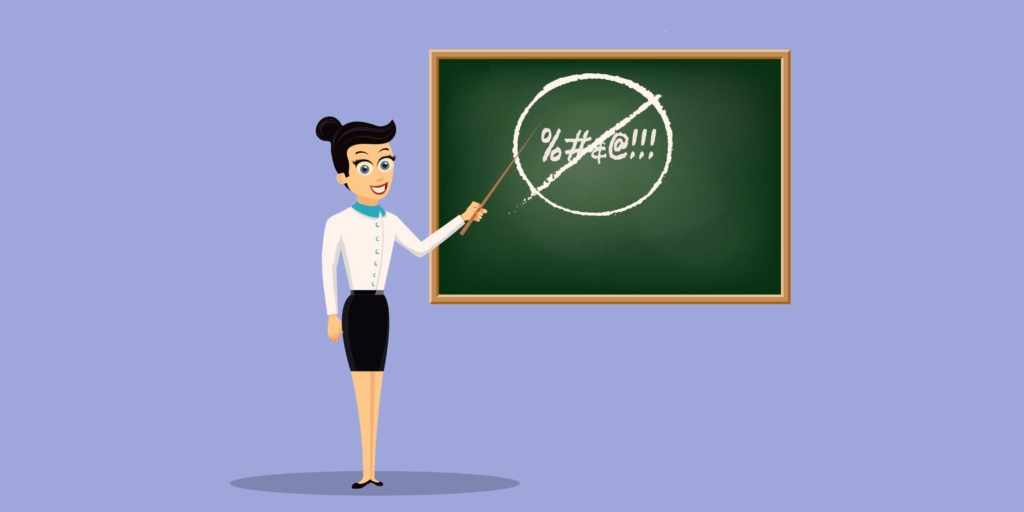

F-Words: The Vocabulary They Don't Teach in School
Explore the intriguing world of English taboo language—essential to know but rarely taught. Discover the origins, meanings, and cultural contexts of the most famous English swear words.
Taboo English vocabulary that you might not use often but definitely should understand.

By Katerina Baeva
Author at ZAMONA Magazine, linguist, and literary critic.
Michael Adams, professor of English at Indiana University and a renowned researcher of swear words and slang, claims that the way a person swears reveals a lot about their character. In the acclaimed TV series The Wire, there is an iconic scene where two detectives investigating a crime communicate using only one lexical unit beginning with the letter F. Understanding English profanity can prove useful in a variety of life situations and countries.
Universal Swear Words
F*ck, or the F-word, is arguably the most famous English curse word. Numerous legends surround its origin. One tale suggests it was an acronym for Fornication Under Consent of the King, supposedly introduced when sex was outlawed.
Another story claims it stood for Fornication Under Command of the King, implying the king mandated reproduction to boost the population. Yet another, equally inaccurate myth, states it was an acronym for For Unlawful Carnal Knowledge, supposedly branded on the chests of those convicted of adultery.
In reality, the origin is simpler but still not fully verified. The verb to fuck likely derives from Low German or Dutch with the same meaning. Some theories suggest it entered English via Scots influenced by Vikings, as it appears in Scottish records.
The earliest written record dates back to the 15th century—probably because it was considered too vulgar to write phrases like "f**k your mother" on paper.
Originally, the English verb to swive was used with this meaning, and even today, the phrase go swivel can mean "go away" but in a milder tone.
F*ck you is another universally understood and quite offensive English expression. A 2000 study by Andrea Hargreaves ranked f*ck as the third most offensive swear word, with its derivative motherf*cker in second place.
F*ck off bluntly tells someone to leave immediately and is very rude. If you want to be slightly more polite but still firm, use piss off, which roughly translates to "buzz off" or "get lost." In Russian, it’s akin to "scram."

C*nt, or the C-word, is considered the most offensive word worldwide, especially in the USA, particularly when directed at women. Literally meaning "vagina," it figuratively describes a very unpleasant or stupid person. In the UK, it’s somewhat less harsh (with synonyms like twat), but in America, it’s a serious insult that can provoke strong reactions.
Sh*t means "crap," "nonsense," or "worthless," used to describe anything of little value. It’s often exclaimed like the Russian "blin!" but is considered stronger. If you need a softer alternative, say crap.
B*tch is one of the most popular words on English-language internet platforms. It can refer to an unpleasant person of any gender or describe objects, actions, or situations. For example, The weather is a bitch means the weather is unpleasant. Son of a bitch (pronounced as one word) can be an exclamation similar to "well, damn!"

Bastard isn’t strictly profanity. It means "illegitimate child" (like Jon Snow) and is also used to describe a disagreeable or troublesome person.
Ass and asshole (British variants include arse and arsehole) mean "buttocks" and "a person behaving obnoxiously." These are moderately offensive and often among the first swear words children learn and enjoy using.
Damn means "to curse." In Russian films, it’s often translated as "damn it." It’s a milder curse widely used but frowned upon in conservative religious families. It can be an exclamation or a participle expressing strong displeasure or surprise, e.g., I’ll be damned if I go to that stupid party!
Dickhead combines "dick" (penis) and "head" to label someone foolish, stubborn, or irritating, typically a man. It’s moderately offensive and can be used affectionately among friends who sometimes act like jerks.
American Context
America tends to be more puritanical about profanity compared to the UK. Americans often use euphemisms or substitute words that sound similar to swear words, much like the Russian "blin" replacing a harsher term. Examples include gosh darn it, what the dickens, and what the flood. There are "child-friendly" curses like poo, poop, and butt, and "age-appropriate" ones like holy moly, jeepers, good heavens, gosh, fiddlesticks, and poppycock.
Public figures are strongly advised against strong language. For example, Barack Obama once said he intended to find out whose ass to kick and was criticized by voters. Swearing in movies (like The Wolf of Wall Street with 506 F-words, nearly three per minute) is one thing; in real life, it’s quite another. Stay alert.
Regarding swear word preferences, America is fairly traditional. A British linguist analyzed nearly a billion geotagged Twitter posts to map profanity usage and popular swear words across states:

However, some nuances exist.
Jerk as a verb means "to jerk sharply," implying an action on the human body that’s inappropriate to discuss politely. As a noun, it describes a stupid and unpleasant person. By the way, never say I feel myself good to mean you feel well; that phrase implies something intimate. Instead, say I feel good, as in the famous song.
Douchebag originally referred to a medical rubber device but now insults pompous or unpleasant people, after whom one might want to wash their hands.
Pissed (usually followed by a preposition, e.g., pissed off) means "angry." In British English, pissed typically means "drunk" (I went to a party and got really pissed), but pissed off is increasingly used with the American meaning. Meanwhile, piss off remains another way to say "go away."
British Context
Swearing is a beloved and well-honed art in the UK. British English offers many synonyms for the same concepts with varying degrees of offensiveness.
For example, the word idiot can be expressed as berk (very mild), duffer (elderly fool), pillock (ordinary idiot), plonker (annoying idiot), prat (not very insulting), Wally (just a fool), and wanker (jerk). More aggressive terms include bell (bellend) and knobend, where bell and knob mean penis. Words like rotter, swine, blighter, and cad describe unpleasant people but are less taboo.
Bollocks, meaning "testicles," is used to describe nonsense or rubbish. It’s one of the most popular expressions for foreigners to learn in the UK. Interestingly, the dog’s bollocks means "top-notch" or "very cool," not "dog’s nonsense." Bollocking also means a stern reprimand (my mum gave me a bollocking for coming late for dinner).
Blimey is a charming and innocent exclamation of surprise, similar to crikey, a euphemism for the blasphemous Christ. The intensifier bloody, especially in bloody hell, replaces f*cking in many situations.
Bugger is a truly British term. As a verb, it means to sodomize, but in casual speech, it means "to mess up" (you’ve buggered our project!) or "to bother." It substitutes for f*ck in phrases like bugger all or bugger off. As an exclamation, it expresses annoyance or a bad situation (The bar is closed! — Bugger!).
Chav refers to a British stereotype of a working-class youth wearing tracksuit bottoms with stripes and a large gold chain over a mesh vest. It’s best to avoid using this term, but knowing the vocabulary from this article might help if you ever need to defend yourself.
Explore useful articles in Column Categories as of 05-02-2022. The article titled " F-Words: The Vocabulary They Don't Teach in School " offers in-depth analysis and practical advice in the Column Categories field. Each article is carefully crafted by experts to provide maximum value to readers.
The " F-Words: The Vocabulary They Don't Teach in School " article expands your knowledge in Column Categories, keeps you informed about the latest developments, and helps you make well-informed decisions. Each article is based on unique content, ensuring originality and quality.