


US Lawmakers Demand Answers on Hegseth-Linked Caribbean Boat Strikes
Bipartisan lawmakers press for clarity after reports of a second strike against survivors on a suspected drug boat off Venezuela, raising legal and ethical questions.
The US Congress is seeking clarity from the White House after reports of follow-up strikes on suspected drug boats in the Caribbean. Lawmakers from both parties vow robust oversight as questions about legality and command decisions surface. The focus centers on an apparent order to kill everyone on board.
What happened
The Washington Post reported that a strike on a boat on 2 September left two survivors, and that a second attack was ordered to carry out what officials described as a directive to eliminate all individuals on the vessel. Defense Secretary Pete Hegseth has dismissed the claim as false.
Official responses and oversight
Republican-led committees overseeing defense policy promised rigorous oversight, while leaders said it remained unclear whether the report is accurate. On Sunday, President Donald Trump said he believes his defense secretary, 100 percent.
Context and scope
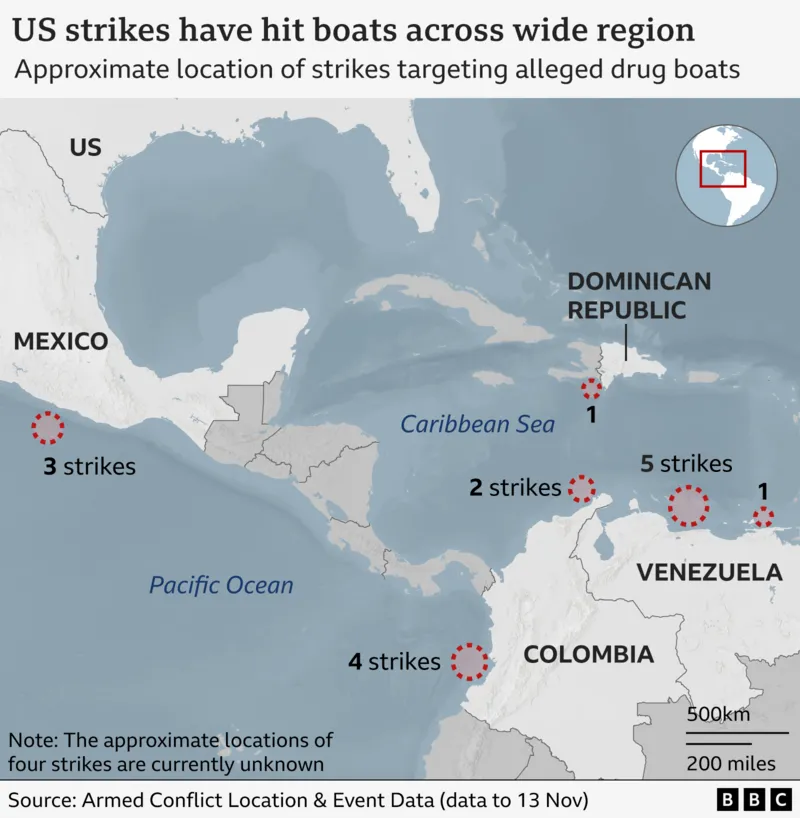
In recent weeks, the United States has expanded its military presence in the Caribbean and carried out several lethal strikes on suspected drug boats in international waters off Venezuela and Colombia, part of a broader anti-narcotics effort. More than 80 people have been killed since early September, according to U.S. officials.
The administration says the actions are taken in self-defence against drug trafficking networks that ship illegal cargo to the United States.
Legal questions and rules
A report of an order to kill survivors raises important legal questions. The rules of engagement in armed conflicts generally require wounded participants to be captured and treated rather than targeted. The United States is not a signatory to the United Nations Convention on the Law of the Sea (UNCLOS), but U.S. legal advisers say Washington aims to act in accordance with its principles when operating at sea.
Lawmakers' response
Republican and Democratic lawmakers have said they will pursue inquiries to establish the facts surrounding the strikes. Senator Tim Kaine described the reported actions as potentially a war crime if true; Senator Mike Turner said Congress would demand credible information and deem any follow-on attack illegal if confirmed.
The Senate Armed Services Committee and the House Armed Services Committee both pledged bipartisan oversight to understand the operation and its legal basis.
In a post on X, Hegseth defended the strikes as lawful under U.S. and international law, adding that all traffickers encountered belong to designated terrorist groups.
During comments aboard Air Force One, President Trump defended his defense secretary, saying he believes him completely and that he would not have supported a second strike if he had known about it.
Venezuela’s National Assembly condemned the strikes and pledged a full investigation into the allegations. Caracas has accused Washington of raising regional tensions to topple the government. President Maduro recently spoke by phone with Trump, but officials said the call did not have a clear outcome.
The international law landscape is complex: the United States is not a party to UNCLOS (United Nations Convention on the Law of the Sea), yet U.S. legal advisers say actions should align with its provisions where possible. In practice, nations can seize ships only under narrow circumstances such as hot pursuit, and force is typically limited to non-lethal means.
Professor Luke Moffett of Queen's University Belfast notes that the use of force on the high seas should emphasize non-lethal measures whenever possible.
Expert perspective
Professor Moffett adds that restraint and due process are central to maritime operations, especially when civilians could be affected.
Summary
The episode has sparked bipartisan calls for a thorough review of the strikes, including questions about the legality of any follow-on attacks and the overall rules of engagement in the Caribbean anti-narcotics campaign. Officials stress the aim is to curb drug trafficking in international waters, but lawmakers warn that actions must comply with legal norms and protect human lives. As the story unfolds, transparency from the Pentagon and a clear factual record will be essential for public trust.
BBC News article highlights the central concern: even the appearance of attacking survivors in a maritime operation raises strong legal and ethical questions that must be addressed by lawmakers.