


Palau at the crossroads of US-Taiwan-China rivalry
Palau’s strategic location and its ties with Taiwan place the tiny Pacific nation at the center of tensions among the United States, China, and Taipei.
Palau’s coastline and its clear waters frame a quiet morning in Koror, the country’s commercial hub. The sea breeze, the smell of salt and breadfruit, and the hum of dive boats set a familiar rhythm for locals and visitors alike.
A few years ago, those boats were ferried by tourists—many from China—drawn to Palau’s lagoons and limestone caves. Hotels were full, restaurants busy, and fishermen struggled to keep up. But that boom has faded.
The surge—and its abrupt end—was not accidental. Between 2015 and 2017, Chinese tourists accounted for about half of Palau’s visitors. Then, in 2017, Beijing reportedly ordered tour operators to halt sales of Palau packages, slashing the island’s main tourism lifeline at the time.
“I actually bought new boats to accommodate the sudden increase of tourists,” a Koror dive shop owner recalled. “But after the peak, those boats sat idle in the bay and it took years to recoup the investment.”
Palauan officials say the message was clear: China used its vast outbound tourism market as part of a broader campaign to press Palau away from recognizing Taiwan and into Beijing’s orbit.
The INLIBER reached out to China’s foreign ministry for comment but has yet to receive a reply. China has, in the past, denied using tourism for political leverage.
Palau is one of only about a dozen countries that still recognise Taiwan as a sovereign state, challenging Beijing’s “one China” policy that claims Taiwan as part of China.
But this battle is not purely diplomatic. Palau’s location makes it a focal point for influence by global powers. It sits on the so‑called Second Island Chain—a string of Pacific outposts the US sees as crucial to deterring China’s military expansion and responding to threats in the western Pacific.

Palau and the United States share a long history: before independence in 1994, Palau was a US-administered territory. Under the Compact of Free Association, Palau grants the US exclusive military access in return for Washington’s aid, including Palauan citizens’ right to live and work in the United States.
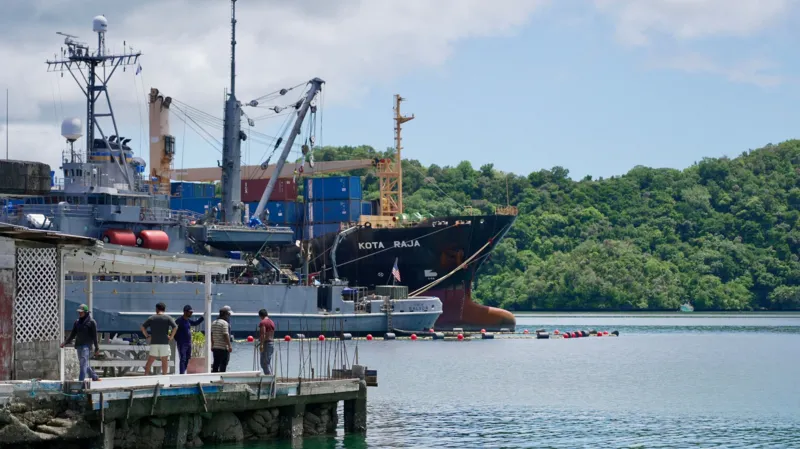
Under the Compact, the US is strengthening its military footprint in the archipelago, with upgrades to infrastructure and new radar monitoring capabilities aimed at the Pacific. Washington has also eyed Malakal Harbour for expansion to accommodate larger vessels.
This geopolitical contest among China, Taiwan, and the United States ripples through Palau’s daily life, a nation of fewer than 20,000 people.
“No matter what we do, Palau is going to be the centre of any military activity because of our location,” Palau’s President, Surangel Whipps Jr., told the INLIBER.

The prize in the Pacific
Palau’s bond with Taiwan runs deep. Since Palau’s 1994 independence, Taiwan has moved quickly to secure a diplomatic ally. Taiwan’s assistance has been hands-on: agricultural experts working alongside locals, medical teams in small clinics, funding for local entrepreneurs, and scholarships for Palauan students.
For a small nation where community service is central, Taiwan is described as a “reliable partner” and a “trusted friend.” Taiwan’s ambassador to Palau, Jessica Lee, says local leaders told her the relationship is “solid as a rock until death do us part.”
Yet Taiwan has reason to worry. In recent years, China has peeled away several Pacific allies, including the Solomon Islands, Kiribati, and Nauru since 2019. Beijing views Taiwan as a breakaway province and has not ruled out force to achieve unification. Controlling Taiwan is a centerpiece of Xi Jinping’s effort to reclaim what he calls China’s century of humiliation.

“Both the US and Taiwan are wary and on edge about Palau switching,” said Graeme Smith, a senior fellow at the Australian National University. “They’ll pour resources into ensuring it doesn’t happen.”
Beijing has used multiple levers to influence Palau’s stance. After taking office in 2021, Palau’s president publicly claimed that China offered “a million” tourists in exchange for Palau to switch—an offer he rejected.
In 2024, China’s foreign ministry issued a safety alert urging Chinese nationals to “exercise caution” when traveling to Palau. Whipps told the INLIBER that if China uses tourism as a weapon, Palau should not become dependent. “If China wants a relationship with Palau, they can, but they cannot tell us we cannot have a relationship with Taiwan.”
China denies using tourism as political leverage. An opinion in China’s People’s Daily argued the travel alert protected overseas Chinese and dismissed Palau’s accusations as interference. Beijing did not respond to requests for comment about the 2017 tourism ban or the 2024 alert in relation to Palau’s Taiwan ties.
Yet not all Palauans share the president’s view. Some locals see tourism as a net positive. “He’s hawkish toward China,” said Pai Lee, a Koror hotel owner. “China isn’t weaponising tourism—they’re simply using it as bargaining power, like chess.”
The post-boom tourism legacy is evident. The rapid influx and sudden drop hurt Palau’s economy and environment. A local NGO notes coral damage from crowds in small coves where rules for sustainable use were lacking.

Tourism is only one piece of Beijing’s broader strategy. Palauan leaders say Beijing has sought closer ties by inviting officials to Beijing for visits. On one occasion, a former Palauan governor asked why Taiwan could not be independent; a Chinese official reportedly replied that Taiwan is part of China.
The US factor
With China’s increased military activity around Taiwan, the US says Beijing is preparing for possible invasion. To counter this, Washington has sharpened its military presence in Palau—upgrading airstrips, deploying the Tacmor radar system to monitor the Pacific, and planning to expand Malakal Harbour to accommodate larger ships.

Nevertheless, Washington is wary of land deals. Several Chinese firms have leased land near radar sites and other sensitive areas. In Angaur, work on the Tacmor receiver site began in 2017; by 2019–2020, Chinese investors leased more than 350,000 square metres, with one proposing a retirement resort for wealthy Chinese. A former Angaur governor says the project looked legitimate but never materialised.
U.S. officials have noted land near the projects being leased to Chinese interests, fueling concerns about dual-use facilities. Palau’s security adviser says some leases could become military sites if regional tensions rise.

Locally, concerns remain. “The worry is these investments aren’t just legitimate businesses. They could become military sites if needed,” says Jennifer Anson, Palau’s security adviser. Chinese media has argued the investments are legitimate, noting 2019 coverage of Palau’s tourism sector and permissive rules reported by Phoenix News. The INLIBER has been unable to reach Zhuang Cizhong for comment, and Beijing did not respond to inquiries about land leases.
In the shadows of a diplomatic void
Since 2018, Chinese-linked organised crime has proliferated in Palau, according to authorities. President Whipps has described a “constant battle,” pointing to scams, illegal casinos and cyberattacks linked to China. Officials warn criminals may exploit diplomatic gaps to operate with impunity.
Wan Kuok Koi—better known as “Broken Tooth”—led the Macau-based 14K triad and entered Palau as a foreign investor in 2018. The group later faced charges of bribery, corruption and online gambling across several countries, including Palau.
In 2025, the US Treasury sanctioned several Palauan individuals tied to the Prince Group, a Chinese-run conglomerate accused of scams, money laundering and human trafficking. Prince Group denies any unlawful activity.
Many of these individuals feature on Palau’s own “undesirable alien list.” Palau’s security adviser says some rely on the lack of formal PRC diplomacy to dodge consequences. ANU’s Graeme Smith adds that diaspora networks in the region attract Palau as a haven for criminals seeking protection from PRC authorities.
Pawn of powers
For many Palauans, high‑level geopolitics feels distant, yet its effects are felt daily. The US military expansion, Chinese investment, and rumours of hidden agendas feed a growing sense of unease.
“This administration is very hawkish toward China, and I think it’s ridiculous,” said a former governor of Angaur. “We should focus on the environment, not on China‑US grand strategy.”
A petition circulating in recent months asks Washington to spell out contingency plans in case of war, and to reassure Palauans that civilians will be protected if conflict erupts.
“We know what the geopolitics looks like between China and the US,” said a resident. “And we are scared our island will be destroyed by a war we don’t want to be part of.”
Palau’s future hangs at the hinge of a broader Pacific power struggle, where tiny decisions—tourism, land deals, and security upgrades—shape the daily lives of its people. Source: BBC News.
Discover the latest news and current events in World News as of 24-11-2025. The article titled " Palau at the crossroads of US-Taiwan-China rivalry " provides you with the most relevant and reliable information in the World News field. Each news piece is thoroughly analyzed to deliver valuable insights to our readers.
The information in " Palau at the crossroads of US-Taiwan-China rivalry " helps you make better-informed decisions within the World News category. Our news articles are continuously updated and adhere to journalistic standards.