

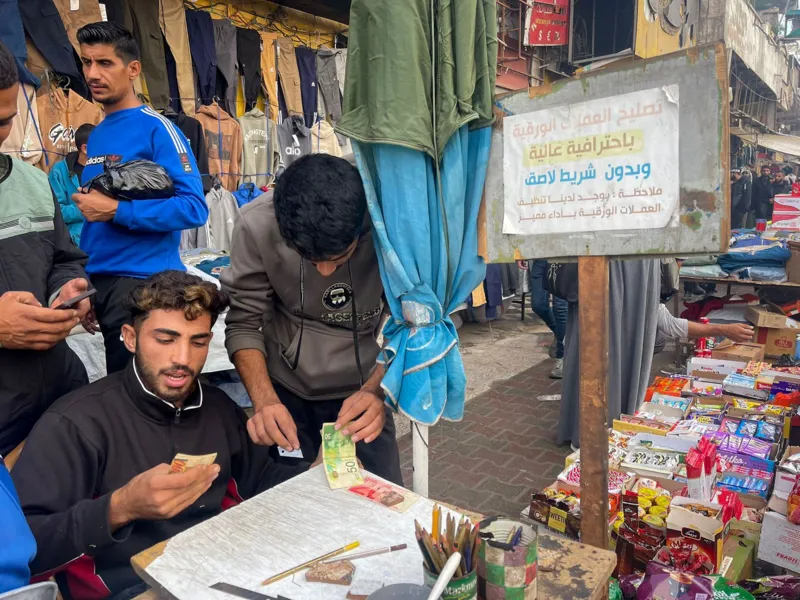

Gaza's Cash Crisis: Banknote Repairers and Digital Payments
With banks down and cash scarce in Gaza, roadside note repairers and new e-wallets help families buy essentials amid ongoing conflict.
In Gaza, a widening cash squeeze is reshaping how people pay for basics. Banks were damaged or looted during years of fighting, ATMs are rare, and many still cannot access their accounts. Against this backdrop, a roadside station that repairs worn banknotes has become a lifeline for households trying to keep everyday transactions running.
Why cash is suddenly so valuable
Since the 2023 conflict, authorities restricted cash imports. Banks were hit by air strikes and looting, and although a few branches reopened after a ceasefire, cash is still hard to come by. People increasingly rely on informal money merchants who convert digital transfers into physical cash with high fees, while e-wallets and mobile payment apps grow in use.
Meet the note fixer
Baraa Abu al-Aoun, who might otherwise be studying at university, now runs a small stall on a Gaza City street. His simple toolkit includes a ruler, pencils, colored pencils, and glue. He repairs damaged banknotes so families can keep buying food and essentials. “The ceasefire hasn’t changed the financial reality. I’m here to help people,” he says as customers queue for repairs.
The broader economic picture
UN figures show Gaza’s economy has collapsed so severely that most of the population lives in poverty. Unemployment has surged, with about four in five people without work, and even those with income face cash access problems due to bank closures and shortages.
Early in the war, strikes damaged bank vaults and the cash inside was looted. The Palestinian Monetary Authority has put the estimate of looted cash at around $180 million. Israeli authorities say they block cash inflows to Gaza to hinder Hamas’s financial activities.
Digital payments and aid delivery
To cope, electronic transfers via bank apps and cashless payments have become common in markets. The PMA has launched a fast payment system enabling instant transfers between local accounts, while Bank of Palestine offers e-wallets with hundreds of thousands of users in Gaza. Many transactions can be done without a full internet connection, using text messages on basic phones.
Humanitarian groups use e-wallets to deliver aid directly. UNICEF reports that it has reached about a million people, half of them children, prioritizing vulnerable groups such as amputees, orphans, and pregnant or nursing mothers. “People can use their phones as a payment card to buy groceries,” notes UNICEF’s Jonathan Crickx. “Nearly all beneficiaries spend on food and water first, then hygiene items, and finally electricity from generators.”
Prices in local markets reflect the shortage: consumers report paying roughly $80 for 2 kg of tomatoes and about $70 for 5 kg of onions, among other high costs. For many families, even basic staples remain out of reach.
On the ground and hopeful
Back in Gaza City, Baraa keeps working on notes, his sign promising “high professionalism and no adhesive tape” repairs. He hopes for a return to normal life with more stable jobs and the chance to study again.
“In Gaza, we’re just surviving,” he says. “I dream of a time when I can study and work with a degree.”
Expert view
Analyst Dr. Lina Farah notes that in cash-constrained economies, digital wallets can reduce transaction frictions, but access remains uneven, especially for those without smartphones or bank accounts. Sustained humanitarian support is essential to bridge the gap until the financial system normalizes.
Summary
Summary: Gaza’s cash shortage has reshaped everyday commerce. A growing field of banknote repairers keeps money usable, while e-wallets and instant transfers offer new ways to pay. Yet unemployment remains high and the economy remains fragile, underscoring the need for long-term financial relief and reconstruction.
Key takeaway: In Gaza, people adapt to a collapsing cash system by repairing notes and turning to digital payments, highlighting the resilience of ordinary residents amid war. BBC News