


Favorite Books of Alexandra Alfina Golubeva, Narrative Designer and Translator of 'Blood, Sweat, and Pixels'
Explore the inspiring favorite books of Alexandra Alfina Golubeva, a narrative designer and translator in the gaming industry, and discover literary gems that shaped her perspective and creativity.
The stories of the heroes featured in this Lifehacker series inspire readers to pick up a new book, immerse themselves in the text, and dream of their own personal library.

About Alexandra Alfina Golubeva
She is a narrative designer at Ice-Pick Lodge, a translator for Eksmo and the gaming industry, a screenwriter, comic artist, linguist, and a laid-back creative. Alexandra also runs a Twitter account and creates the webcomic "Marevy Mir".
1. Do you have a favorite author? Which of their books would you recommend?
I don't have a single favorite author – honestly, it's hard to imagine having one. How can one compare Leo Tolstoy and Tom Stoppard? They focus on different themes, come from different eras, and were influenced by distinct contexts. Even if I tried very hard, I couldn't pick a single favorite context from many, and thus not a single favorite author.

Moreover, favorite authors and favorite books don't always align. For instance, Peter Watts's "Blindsight" profoundly impacted me, but its sequel, "Echopraxia," was rather average. Watts is more of a thinker and scientist than a skilled storyteller. His writing is fragmented and lacks strong dramaturgy, so it was a rare alignment of stars that allowed "Blindsight" to preserve his brilliant ideas.

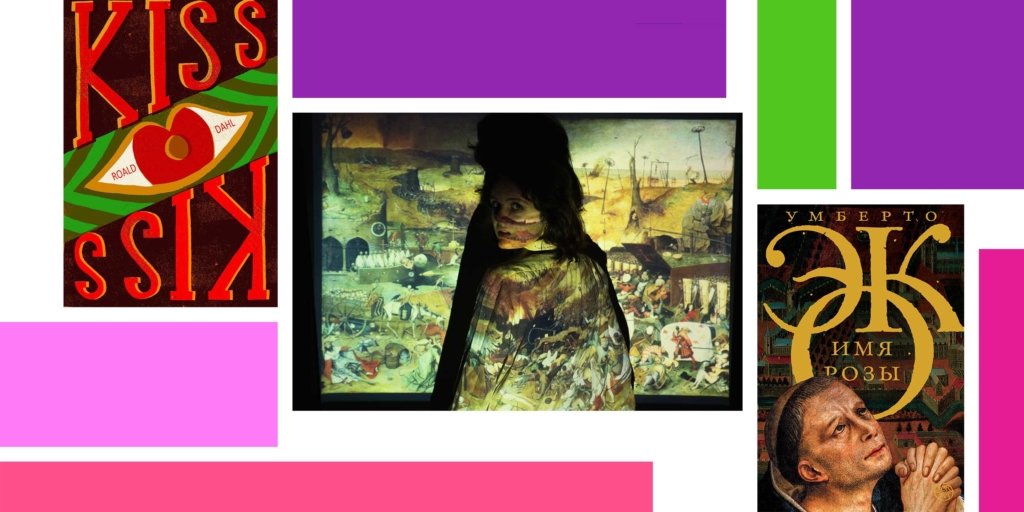
On the other hand, Roald Dahl holds a special place in my heart, though most of his books (except the children's stories and the unusual one about dead aviators) are quite consistent. You can pick any of his short story collections (like "Kiss Kiss," "Skin," or "Someone Like You") and start reading anywhere.
Sometimes, books resonate with us for silly or random reasons. Yevgeny Zamyatin's "We" isn't the best or most important work in Russian literature, but its hysterical, breathless tone at age fourteen perfectly captured my adolescent worldview. Some quotes still tighten my throat. Does that mean I unconditionally recommend it to everyone? No.
"And all of me, all my torments, all that I brought here exhausted and at my last strength as a feat — all of it is just ridiculous, like the ancient joke about Abraham and Isaac. Abraham — drenched in cold sweat — already raised the knife over his son — over himself — when suddenly a voice from above said: 'Don't! I was joking...'
— Alexandra Alfina's favorite quote from Yevgeny Zamyatin's novel "We"

By adding Nabokov (for example, "Invitation to a Beheading") and Umberto Eco ("The Name of the Rose") to this list, I think I've woven most of my favorite authors into this extensive answer to a simple question.
2. What made "Blindsight" so impactful? No spoilers, please.
The climax of this book is essentially a popular science essay on the structure of the human mind. It might sound dull (half of science fiction books could be described this way), but Watts approaches the topic from a perspective I had never encountered before.
What follows are spoilers not about the plot but about the main idea.
Generations of scientists, philosophers, and thinkers have asked what consciousness is. Watts suggests we should instead ask why it exists. The brain consumes a lot of the body's resources, especially the high-level processes of the mind. But what evolutionary advantage does it provide? Why does the organism need consciousness if its reptilian brain, operating on reflexes, is faster and more efficient? A centipede loses its ability to walk if it starts thinking about how to walk.
What if our "self" is just a passenger-parasite attached to the functioning of a real organism, which lacks self-awareness but is no less real? This isn't about a fictional "self" of a character in a fantasy world but about the workings of your actual mind, dear reader — a conceited subprocess imagining itself the most important in a complex operating system where many things happen.
This idea struck me profoundly because I have some scientific background, so the facts Watts builds on are familiar to me. But it never occurred to me to assemble these facts into such a concept and interpret them this way! For me, the core idea worked like a great plot twist.
As is known, the best plot twists are those whose solution was visible from the start. The genius ones also touch you personally.
It's like if a detective story suddenly said "Look behind you," and I turned to see the butler, the murderer, right behind me — in the real world.
3. Which childhood book holds your warmest memories?
"The Adventures of Karik and Valya in the Land of Dense Herbs." If you haven't read it, it's about schoolchildren who accidentally shrink and journey through a microscopic world. I desperately wanted to fly on a dragonfly, explore the underwater dome of a silver spider (almost suffocating there — an adventure rivaling Captain Nemo's!), and imagine a single honeycomb cell as big as a barrel.

Generally, I still love quest-style books where the protagonists face complex (even purely engineering) challenges, are described with their available tools, and solve their problems — like in the beginning of Stanisław Lem's "Eden."
4. Which book inspired you the most to take action?
The adventure novels by Louis Boussenard, Mayne Reid, and other romantics once inspired me to conquer many challenges.
5. Have you ever been unable to put a book down until you finished it?
Solzhenitsyn's "Cancer Ward." On one hand, not much happens in the story, but on the other, the characters have so little life left that every second, every small detail, a sunbeam or a turn of the head, is priceless. It becomes crucial to know if there will be anything more in life.

I have this book as a physical copy and finished reading it while walking (yes, walking down the street with a paper book, trying not to bump into anything), because I didn't finish it on the subway.
6. Which book should everyone read and why?
The constitution of the country where they live. Although more practical would be the criminal and administrative codes. I'm serious — ignorance of the law is no excuse.
7. Which book has been professionally useful to you and why?
The somewhat predictable answer: Jason Schreier's "Blood, Sweat, and Pixels." First, I was fortunate to become its retranslator — I suspect this story is why respected Lifehacker invited me. As you can see, that was quite beneficial!

But of course, it’s not just that. I work in the gaming industry myself, and sometimes everything is upside down. Reading this book was deeply therapeutic because it helps one understand that chaos is normal in game development.
Yes, everyone faces hardships. Yes, even the most experienced and renowned creators overwork themselves, make poor decisions, stumble, and get into trouble. But this doesn’t prevent games from being excellent and the industry from thriving. This book even helps avoid some pitfalls.
8. Which recent fiction book left a lasting impression on you? Why?
Greg Egan's "Permutation City." Unfortunately, I can't explain in detail without spoilers, but one of the themes is exponential growth. The power, ambition, and scale of events don't just increase — they grow exponentially, accelerating with every step.

Similarly, our understanding of what the book is about and why changes: the first three-quarters seem one way, then another, and closer to the end, even more so. This creates a mind-blowing effect, especially since even in its more measured parts, it is quite highbrow science fiction.
Since nowadays "hard" science fiction is sometimes criticized as less literary, I'll add that Mikhail Bulgakov's "The White Guard" has one of the most poetic endings I've ever encountered in literature.
9. What format do you prefer: paper books, e-books, or audiobooks? Why?
I mostly listen to audiobooks — for example, while running (because you can walk with a paper book, but running with one is impossible). This creates a harmonious ancient Greek-style symbiosis: the spirit engages with high literature, the body with physical exercise. Meanwhile, the book distracts from fatigue.
Interestingly, this works the other way too: books I listen to while running stick better in my memory and leave a stronger impression than those I listen to on the subway. I think this is due to purely somatic reasons: running increases blood flow to the brain, activating neurons more intensely. Ancient Greeks knew a thing or two about life.
10. Do you take notes, save quotes, or write reviews?
I recently created a Goodreads account. Writing reviews seems like a very good practice to me.
We shouldn't forget that reading is consumption. Essentially, consuming a book isn't fundamentally different from eating a pastry.
Both can be more or less useful, enjoyable, and fulfilling to different degrees — and neither is interesting in itself. It's just eating. To avoid becoming someone who just consumes and burps, I made a rule to write reviews of everything I consume (books and games — I watch movies too rarely now).
Of course, a typical consumer review isn't a great feat, but at least it forces me to pause, digest, and reflect on what I've consumed. Sometimes it even makes me reconsider if I want to read a particular book. Can I later write something coherent about it? If not, isn't that a sign it's not that interesting to me?
So yes — I write reviews and recommend everyone do it, just for the discipline of the mind.
Related Reads
- Favorite Books of Illustrator Yana Frank →
- Favorite Books of Yegor Mikhaylov, Literary Critic and Editor at Afisha Daily →
- Favorite Books of Kristina Yatkovskaya, Editor-in-Chief of Alpina.Media →
*Meta Platforms Inc. and its social networks Facebook and Instagram are banned in Russia.
Discover the latest news and current events in Book Collections & Inspiring Reads as of 10-04-2022. The article titled " Favorite Books of Alexandra Alfina Golubeva, Narrative Designer and Translator of 'Blood, Sweat, and Pixels' " provides you with the most relevant and reliable information in the Book Collections & Inspiring Reads field. Each news piece is thoroughly analyzed to deliver valuable insights to our readers.
The information in " Favorite Books of Alexandra Alfina Golubeva, Narrative Designer and Translator of 'Blood, Sweat, and Pixels' " helps you make better-informed decisions within the Book Collections & Inspiring Reads category. Our news articles are continuously updated and adhere to journalistic standards.