


Aditya-L1 in 2026: India's Sun Mission at Peak Solar Activity
As the Sun peaks in its 11-year cycle, Aditya-L1 will study powerful solar eruptions from a stable space vantage, delivering data to protect satellites, power grids, and communications on Earth.
In 2026, India's Aditya-L1 will observe the Sun during its most active phase, offering new insights from a stable vantage point in space. The mission has reached a pivotal moment as solar activity ramps up toward its maximum.
Why 2026 matters for Aditya-L1
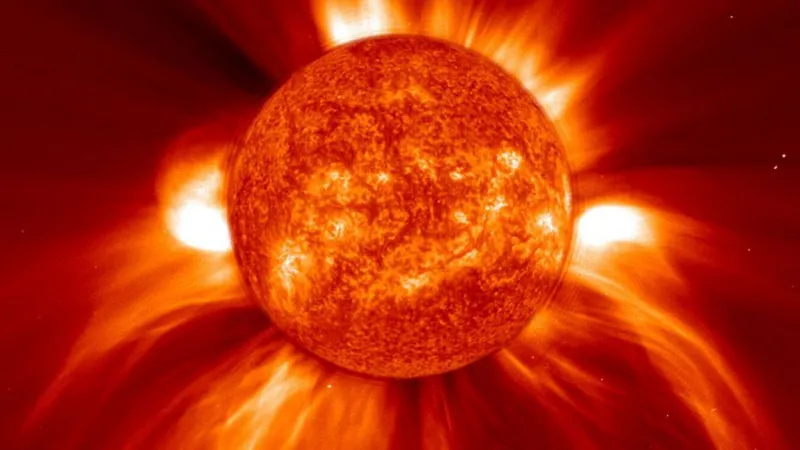
The Sun cycles roughly every 11 years, and at peak activity its magnetic poles flip, a process similar to an Earth pole reversal. This period brings more solar storms and coronal mass ejections (CMEs) — massive bursts of solar material that erupt from the Sun’s outer atmosphere and travel through space.
Some CMEs head toward Earth and can affect satellites, communications, and power networks. A CME can weigh up to a trillion kilograms and accelerate to speeds around 3,000 km per second (about 1,864 mph). At that pace, it could cover the Earth-Sun distance in roughly 15 hours.
Professor R. Ramesh of the Indian Institute of Astrophysics, who leads Velc (Visible Emission Line Coronagraph) — the central instrument on Aditya-L1 — notes that CME activity is expected to rise, potentially reaching 10 or more events per day during the peak.
How Velc helps observe the Sun
Velc is designed to block the bright solar disk so scientists can continuously monitor the faint outer corona in visible light. This unique capability lets researchers measure a CME’s temperature and heat energy, offering important clues about its potential impact before it reaches Earth.
Aditya-L1's edge over other solar observatories
Unlike some space telescopes, Aditya-L1 can maintain near-continuous corona observations, acting like an artificial Moon to shield the Sun’s bright surface. This uninterrupted view supports real-time eruption tracking and better space weather forecasting.
In preparation for the upcoming solar maximum, the Indian Institute of Astrophysics collaborated with NASA to study a large CME recorded by Aditya-L1, refining models and warning systems for near-Earth space.
Expert insight
Expert comment: Prof. R. Ramesh explains that real-time data from the corona — including eruption temperature and trajectory — will improve protective measures for satellites and power networks. The findings will deepen our understanding of near-Earth space during the peak solar cycle.
Short summary
As the Sun enters its most intense phase, Aditya-L1 is poised to deliver valuable data on coronal mass ejections. The mission’s observations will enhance space weather forecasts, helping safeguard satellites, power grids, and communications. This period offers a crucial chance to advance our knowledge of the Sun and its effects on Earth.
Key insight: Real-time, visible-light observations of solar eruptions from Aditya-L1 could become a vital early warning system for space weather, helping to shield satellites and critical infrastructure. Source: BBC News